
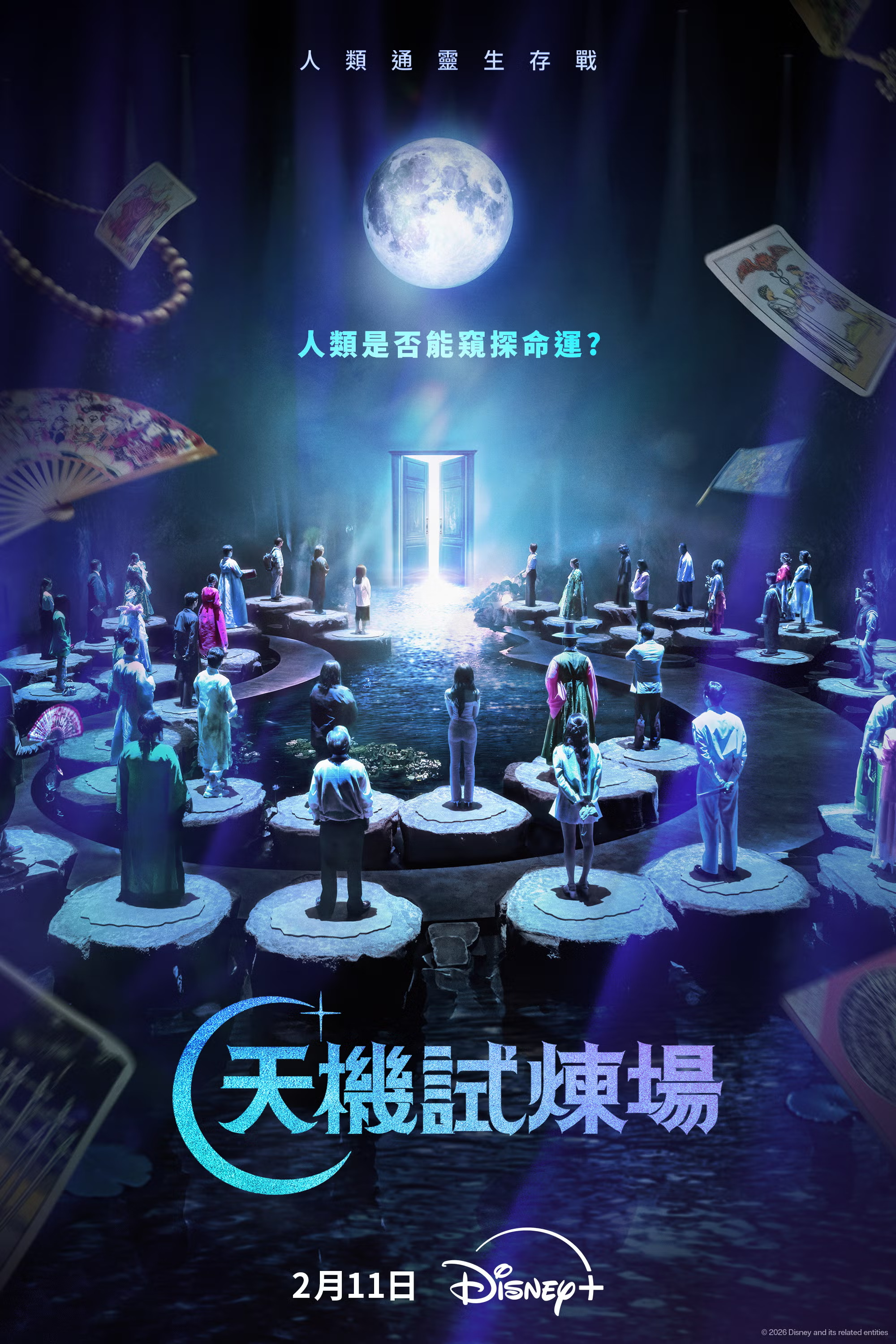
Korea's metaphysical reality show Tianji Trial Ground has exploded online. Young shamans ring bells, switch voices, and reveal private details that leave audiences stunned.
After the shock, one practical question remains:
- Why can psychic mediums feel so accurate?
- How is that different from Tarot?
- Why do many people call I Ching Liuyao the most "analytical" system?
Because these are not variations of the same method. They are three different information engines.
1. Korean psychic mediumship: a spirit-signal receiver
In the show, the most dramatic moments come from Korean spirit-medium practice (Mudang). Its core is not calculation, but reception.
A medium acts like a receiver: the "source" is interpreted as spirits, ancestors, or deity channels. The strength is vivid specificity, details that feel impossible to infer normally.
But there are clear limits:
- Heavily dependent on the practitioner's state that day
- Often result-focused, with little verifiable reasoning path
- Can create fear-based dependency in seekers
If you want more context on Korean shamanic roles, read: What are Dongja, Doryeong, and Manshin in Korean shaman culture?
2. Tarot: symbolic projection of the subconscious
Tarot uses 78 symbolic cards. In practice, it works like a psychological mirror: your present intention resonates with symbolic archetypes, and the reader translates that pattern into a narrative.
Tarot is especially strong for:
- Emotional dynamics
- Relationship ambiguity
- Self-awareness and inner conflict
It often feels therapeutic and clarifying.
Its blind spot appears when you need hard timing or execution-level decisions (for example, exact contract windows or risk timing in business). Tarot may offer direction, but not always operational precision.
3. I Ching Liuyao: an energy-logic simulation model
Liuyao does not rely on possession or image intuition. It encodes the moment of divination (year, month, day, hour) and line changes into an energy model.
In this model, key actors (you, counterpart, money, work, pressure, support) are mapped into structured positions, then analyzed through five-element interactions and timing shifts.
Why Liuyao is different:
- It gives both trend and timing windows
- It explains why a situation is blocked
- It produces actionable strategy (when to push, wait, or stop)
Recommended reads:
- How to read your result: original hexagram vs transformed hexagram
- Why your readings feel inaccurate: 5 high-precision question rules
- How to prepare before divination for cleaner signals
One-line comparison
- Psychic mediumship: signal-based, strongest at shocking specificity
- Tarot: psychology-based, strongest at emotional mapping
- Liuyao: model-based, strongest at timing and strategy
If you want to be amazed, psychic reading may do that. If you want emotional reflection, Tarot is excellent. If you want decision support for real-world action, Liuyao is usually the better tool.
Do you want prophecy, or navigation?
The viral success of Tianji Trial Ground reflects a modern anxiety: everyone wants certainty.
But destiny is not a fixed script. It is a dynamic system where timing and choices matter.
At PurpleStarMapper, we combine classical I Ching Liuyao logic with modern AI computation to produce calm, practical, and execution-ready guidance.
👉 Start your AI Liuyao reading now ➔
For deeper strategy when stakes are high: Advanced Liuyao Reading
