1. Introduction: Why the Ji-Ju Structure Has So Much Tension
In Zi Wei Dou Shu, the pairing of Tian Ji and Ju Men in the Mao and You palaces is one of the most discussed double-star structures. It combines two powerful currents at once:
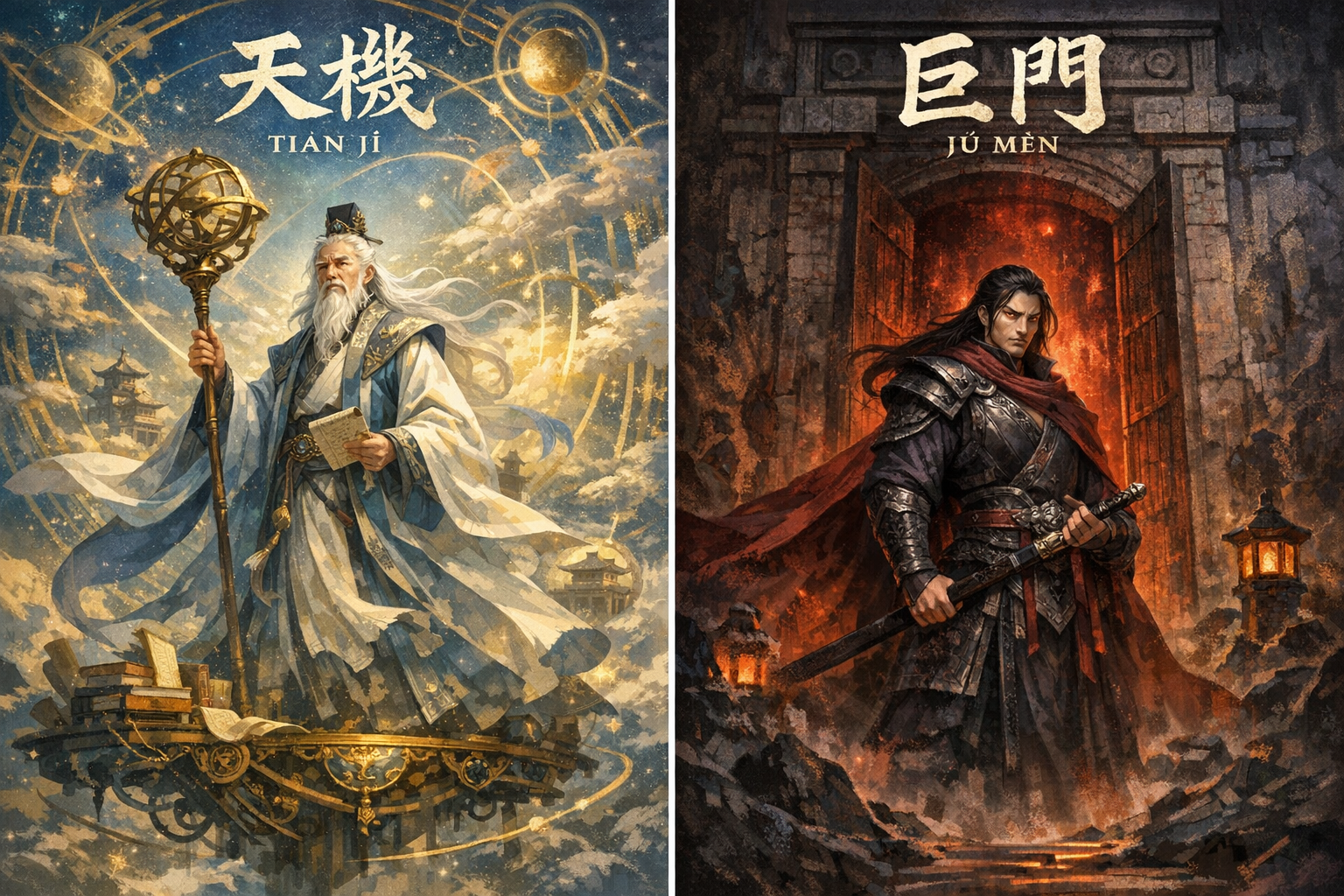
- Tian Ji: fast thinking, mobility, planning, and adaptive intelligence.
- Ju Men: suspicion, research, language, hidden factors, and conflict through speech.
That is why this pattern is never just about “being smart” or “speaking well.” It is a configuration built on high sensitivity, heavy mental processing, and a constant need to respond to environmental complexity.
Traditional commentary often says this structure can indicate both upheaval and success. That is not a contradiction. The logic is simple: the person usually has to pass through instability, misreading, or repeated strategic adjustment before the pattern matures into authority.
This article breaks the structure down through five lenses: star essence, psychological wiring, Mao/You palace differences, opposite-palace pull, and the role of the Four Transformations.
2. Star Essence: Flexible Intelligence Meets Shadow Analysis
2.1 Tian Ji: agile, strategic, and easily overloaded
Tian Ji belongs to yin wood and is associated with benevolence, flexibility, planning, and nervous-system responsiveness. It behaves like a high-speed processor: quick to detect change, quick to compare options, quick to optimize strategy.
Its weakness is equally obvious. Tian Ji does not naturally hold the center like Zi Wei, nor does it endure brute-force execution like Wu Qu. When the environment is too unstable, Tian Ji can become:
- multi-threaded but indecisive,
- over-planning and under-committing,
- too sensitive to external fluctuation.
In other words, Tian Ji is powerful, but it needs structure. Without a stable frame, intelligence remains scattered.
2.2 Ju Men: deep observation, sharp speech, and chronic misunderstanding risk
Ju Men governs what is hidden: ambiguity, inquiry, critique, research, speech, and controversy. Its strength comes from not trusting surfaces. It wants to know what is concealed behind words, motives, systems, and appearances.
Professionally, this is excellent energy for:
- research and error detection,
- analysis and consulting,
- law, education, negotiation, and commentary.
But the same mechanism creates social cost. A person who constantly detects flaws and hidden motives can sound harsher than intended. Common outcomes include:
- “sharp mouth, soft heart,”
- a sincere search for truth being received as attack,
- unnecessary friction caused by tone rather than intent.
3. Psychological Structure: the planner and the auditor in one person
When Tian Ji and Ju Men join, they form a highly specialized inner model:
Tian Ji builds the framework. Ju Men stress-tests it.
People with this structure usually:
- do not trust appearances easily,
- build mental models quickly from fragmented information,
- notice loopholes, rhetorical tricks, inconsistencies, and hidden risks faster than most people.
That makes them well suited for fields requiring brainpower, language, and system judgment: consulting, law, teaching, strategy, research, brand advisory, and high-level analytical sales.
The difficulty is not lack of ability, but high internal load. Tian Ji’s nervous sensitivity plus Ju Men’s suspicion can easily become over-processing:
- thinking too fast and too much,
- treating ordinary social friction as a full risk audit,
- wanting precision in expression but internally revising everything to exhaustion.
So the mature lesson of this structure is not to suppress intelligence. It is to learn when to analyze, how much to say, and how sharply to deliver it.
4. Palace Differences: Mao externalizes talent, You pressure-forges depth
4.1 Mao palace: talent is easier to express
Mao is an eastern wood palace. Tian Ji is strengthened here, and Ju Men’s darker analytical nature is more easily converted into communication, persuasion, and knowledge-based output.
Typical Mao Ji-Ju traits include:
- very fast learning,
- rapid integration of skills and information,
- more visible professional development through speaking, teaching, consulting, or cross-domain work.
This version of the structure often benefits relocation, travel, cross-border work, or knowledge industries. The “upheaval” here usually looks more like early-stage experimentation than deep structural damage.
4.2 You palace: more pressure, more friction, stronger eventual backbone
You is a western metal palace, and metal restrains wood. That puts greater pressure on Tian Ji’s adaptive intelligence. The mind remains quick, but tension, anxiety, and stress tend to increase.
This is why You Ji-Ju is more often linked to the classical “upheaval pattern”:
- more unexpected career and interpersonal disruptions,
- stronger mismatch between outside evaluation and inner experience,
- repeated need to repair, reorganize, and rebuild.
But that same pressure is also what matures the chart. It forces cleverness to become skill, and temporary eloquence to become durable professional capacity. If the person learns to stabilize under pressure, You Ji-Ju can build extremely strong depth.
5. Opposite-palace pull: Tai Yang and Tian Tong reshape how the pattern lands
This structure cannot be read from the natal palace alone. The opposite palace shows how one’s intelligence and language meet the outside world.
5.1 Tai Yang pull: turning controversy into visibility
If the opposite palace contains a strong Tai Yang, Ju Men’s darkness is illuminated. Critique and analysis no longer remain hidden or misunderstood so easily; they can transform into public position, visibility, and reputation.
Common signs:
- better luck outside the home base,
- stronger mentor or benefactor support,
- speech that would otherwise cause friction becoming a source of recognition.
5.2 Tian Tong pull: emotional buffering, but sometimes less drive
If Tian Tong influences the opposite palace, the native often appears softer and more approachable in external dealings. This can reduce Ju Men’s harsher edge.
However, if Tian Tong is weak, another issue appears: the person can think clearly but feel emotionally tired when exposed to too much movement or social demand. The problem is not competence, but lack of emotional recovery.
6. Four Transformations: how the Ji-Ju pattern actually outputs power
The upper and lower range of this structure is heavily shaped by the Four Transformations.
6.1 Tian Ji transforms to Lu: strategy becomes income
This is one of the best financial expressions for the pattern. The person’s planning skill, information edge, and analytical flexibility can directly convert into money.
Typical manifestations:
- earning through consulting, strategy, analysis, or technical judgment,
- packaging complexity into usable solutions,
- being repeatedly chosen for mental output rather than raw labor.
6.2 Ju Men transforms to Lu: speech and persuasion become assets
Ju Men to Lu is the classic “speaking generates wealth” expression. This is not merely charm. It is the ability to explain complexity clearly enough that people trust, buy, follow, or learn.
It strongly supports:
- teaching and public speaking,
- legal and negotiation work,
- media, branding, and PR.
6.3 Ju Men transforms to Ji: conflict, legal trouble, and misunderstanding intensify
This is one of the most difficult variations for Ji-Ju. Speech-related friction becomes amplified into:
- contract disputes,
- defamation or reputation crises,
- career stagnation caused by verbal intensity.
The right strategy here is not aggressive confrontation. It is disciplined communication, written documentation, and controlled exposure.
6.4 Tian Ji transforms to Ji: the decision system overloads
When Tian Ji transforms to Ji, the issue is not simply being busy. The decision engine itself becomes unstable. Too many variables, too many revisions, too much mental recursion.
This is not a good period for:
- high-risk investing,
- impulsive career switching,
- major commitments under incomplete information.
7. Conclusion: the wise strategist formed through repeated correction
The Tian Ji–Ju Men pattern is difficult precisely because it is not a comfortable one. It gives the native high perception, strong analysis, and fast pattern recognition, but it also exposes them to misunderstanding, friction, and self-doubt.
So the real professional question is never just, “Will this person suffer upheaval?”
It is:
- Can they turn upheaval into experience?
- Can they turn suspicion into insight?
- Can they turn verbal conflict into real authority?
When Ju Men’s dissecting power is used for construction rather than consumption, and Tian Ji’s flexibility is used for strategy rather than anxiety, this pattern evolves from a restless seeker into a deeply credible expert.
If you want to understand whether your own chart is trapped in internal friction or preparing for a major professional restructuring, start with our Free Divination and read the structure behind your current situation.
