In executive environments and high-stakes business, there is one type of leader people respect and fear at the same time.
They are not symbolic managers who hide behind dashboards. When a company is near collapse, a project is trapped, or an entire sector is being reset, these are often the only people willing to step into the fire, cut dead weight, and rebuild order from ruins.
They move fast, decide hard, and can look ruthless. But one fact is hard to deny: they can win in conditions where most people freeze.
Why do some people retreat in crisis while others become more commanding under pressure?
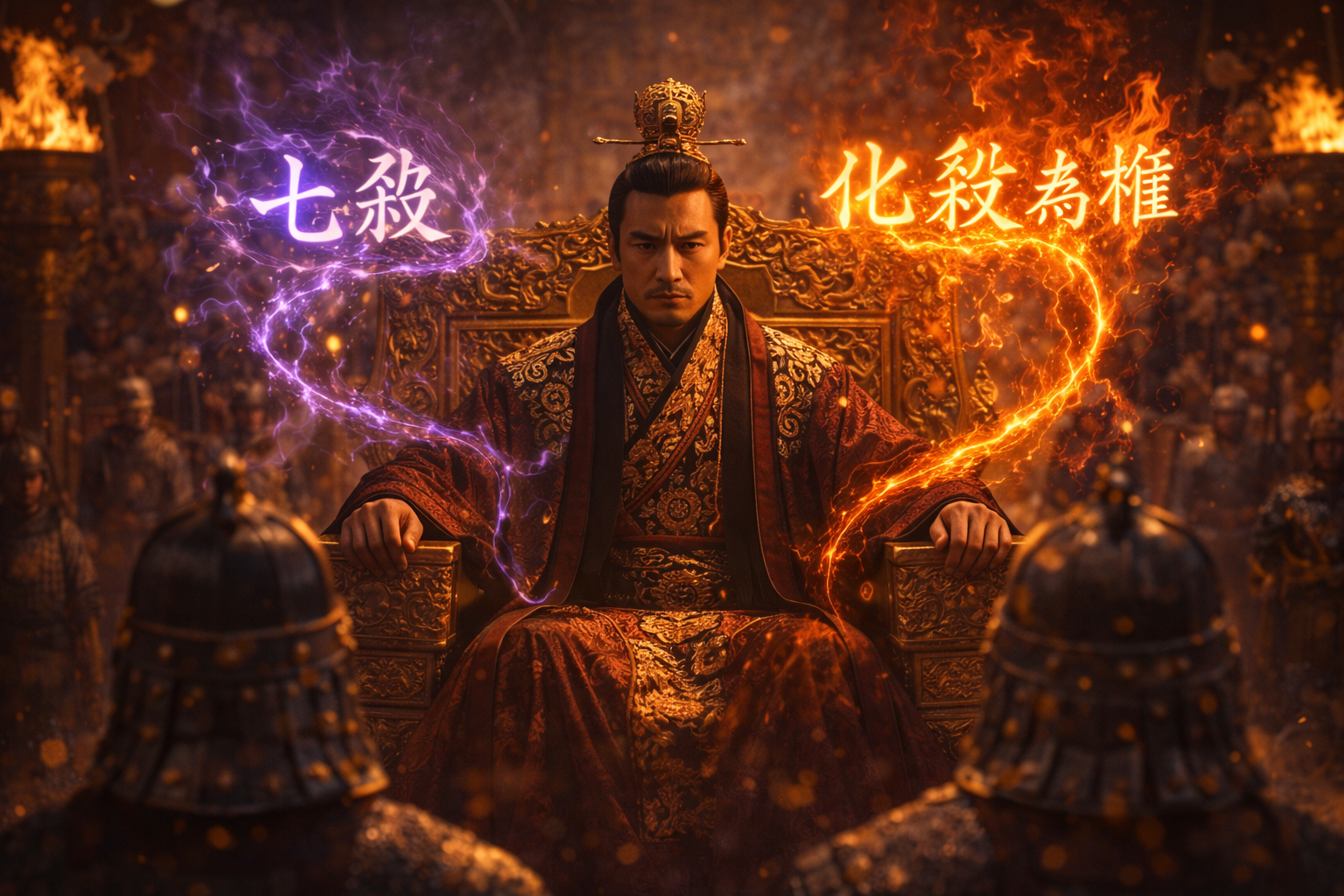
In Zi Wei Dou Shu, this war-time commander profile is often tied to one extreme dual-star code: Zi Wei + The Pioneer (Qi Sha), often called the Zi-Sha pattern.
This is Part 2 of our dual-star series. Here we decode one of the most iron-blooded combinations in the system. If you, your boss, or your competitors carry this pattern, understanding it explains why comfort feels like punishment to them and how, in 2026 turbulence, solitary killing force can be converted into irreplaceable command authority.
The Emperor and the Field General: Absolute Nobility Meets Absolute Severity
To read Zi-Sha correctly, return to star-level architecture.
Zi Wei (The Emperor) is the central sovereign star. It seeks dignity, control, and strategic command. On its own, Zi Wei can become high-position dependent. Without support stars such as The Active Supporter (Zuo Fu) and The Subtle Supporter (You Bi), it may drift into "high-level direction, low-level execution" and become a detached lone ruler.
Qi Sha (The Pioneer) is Yin Metal. It is the field general and one of the strongest severity signatures in the chart. Its core is rationality, decisiveness, and execution speed. It dislikes constraint, drives hard toward targets, and often lives through sharp rises and falls.
What happens when both share one palace (Si or Hai)?
Zi Wei logic calls this: transforming killing force into authority.
When The Emperor's command instinct links with The Pioneer's cutting force, Zi Wei stops being ceremonial and picks up the blade. The Pioneer's raw aggression is no longer uncontrolled; it is absorbed into strategic governance and becomes real power.
That is why Zi-Sha profiles often show terrifying real-world execution. They are not chasing decorative status. They want control, throughput, and concrete outcomes. They are naturally suited to entrepreneurship, crisis restructuring, M&A integration, and hard-turn operations.
Si Palace vs Hai Palace: Same Power, Different Rule Style
Zi Wei + The Pioneer can only co-locate in two positions: Si Palace and Hai Palace. Same stars, different governance temperament.
1) Si Palace Zi-Sha: Fire-Tempered Steel, Overt Iron-Hand Style
Si carries Fire while The Pioneer is Metal. This is high-heat forging.
This profile usually has stronger visible authority, harder edges, and a higher control drive. Decisions are fast and cutting. Resistance is often handled by direct force. They can build feared empires quickly, but can also trigger strong backlash if control becomes excessive.
2) Hai Palace Zi-Sha: Deep-Water Dragon, Hidden Strategist Style
Hai carries Water and depth.
Here, dominance is less theatrical and more strategic. This profile is often an invisible power-holder. Emotional display is low, timing discipline is high, and the decisive strike often appears when opponents are least prepared. They seek command, not applause.
The Price of Zi-Sha: Power Is Bound to Isolation
Whether in Si or Hai, Zi-Sha carries a fixed cost: extreme isolation and extreme internal load.
Zi Wei is inherently elevated and solitary; The Pioneer is inherently severe and independent. Combined, trust thresholds become very high. These people over-own responsibility and prefer doing things themselves, even with strong teams.
That "I can only trust myself" loop drives chronic overload. If unmanaged, midlife risk rises, especially for cardiovascular strain and accident-related injury.
2026 Survival Rules: How to Carry the Crown
2026 is a transition year: old systems erode, new systems are unfinished. For Zi-Sha, this is a strategic window. Stable eras may not need battlefield generals. Disorder does.
But if you want durable rule, not short-term conquest, three rules are critical.
Rule 1: Leave Greenhouse Environments and Take Broken Systems
Zi-Sha is coded for creation-through-conquest. In highly stable, low-friction environments, this profile often feels caged and turns unused intensity into internal conflict.
Go where complexity is real:
- launch new ventures or difficult business lines
- inherit failing units and rebuild them
- enter markets others avoid
Zi-Sha wealth and status are usually built by solving disasters others cannot solve.
Rule 2: Avoid the Dictatorship Trap and Force Delegation
You may be strong, but solo control does not scale forever. Zi-Sha's biggest bottleneck is often self-created.
Because speed matters to you and tolerance for error is low, you may centralize all decisions and become a high-paid slave to your own system.
Real "transforming blade into authority" means not only having power, but distributing it intelligently. Build process, tolerate controlled mistakes, and design succession depth.
If your chart lacks supportive stars (e.g., Zuo Fu / You Bi), your lifelong management assignment is clear: trade profit-share, equity, and structure for other people's time and loyalty.
Rule 3: Accept Solitude and Build Hard Boundaries
Isolation is part of the Zi-Sha curriculum. In close relationships, your dominance, rational rigidity, and control style can suffocate partners.
Many Zi-Sha profiles switch into total work mode and emotionally exit family systems. The fix is domain separation and expectation management:
- do not bring command-style management into private space
- do not demand full emotional symmetry from family
- schedule non-negotiable recovery and relationship maintenance blocks
When battlefield intensity stays in the battlefield, solitude becomes strategic focus, not emotional collapse.
Turn Crisis into Script: Lion with Seal, or Beast in a Cage?
In a high-pressure era, Zi Wei + The Pioneer can look like built-in crisis immunity. But unchecked immunity can become auto-immune damage.
Are you a battle lion with command seal, or a trapped beast crushed by trivial operations? Is your authority conversion stable, or is annual Hua Ji turning your style into destructive authoritarian drift? Are health and relationships paying for your expansion ambition?
Dual-star chemistry is precise.
- With The Blade (Qing Yang) and The Flare (Huo Xing), explosive force can become exceptional, but rollover risk rises equally fast.
- With The Scholar (Wen Chang) and The Muse (Wen Qu), outcomes are not always positive. In some contexts this becomes a mismatch: hesitation when decisive cutting is required.
Do not let imperial-level talent degrade into pure attrition.
If you want a precise answer to whether your chart holds this command-power code, if you are at a life-or-death startup stage, considering a high-risk executive role, or trapped in team-trust exhaustion, this is your timing.
Book your StarPath AI Zi Wei Master Analysis Report now. We will decode your dual-star structure, map dictatorship traps and power levers, and design your expansion and crisis-control roadmap.
Move today. Turn extreme crisis into your upward launch platform and write your own imperial script.
👉 Unlock my Zi Wei + The Pioneer command-power strategy report now →
