
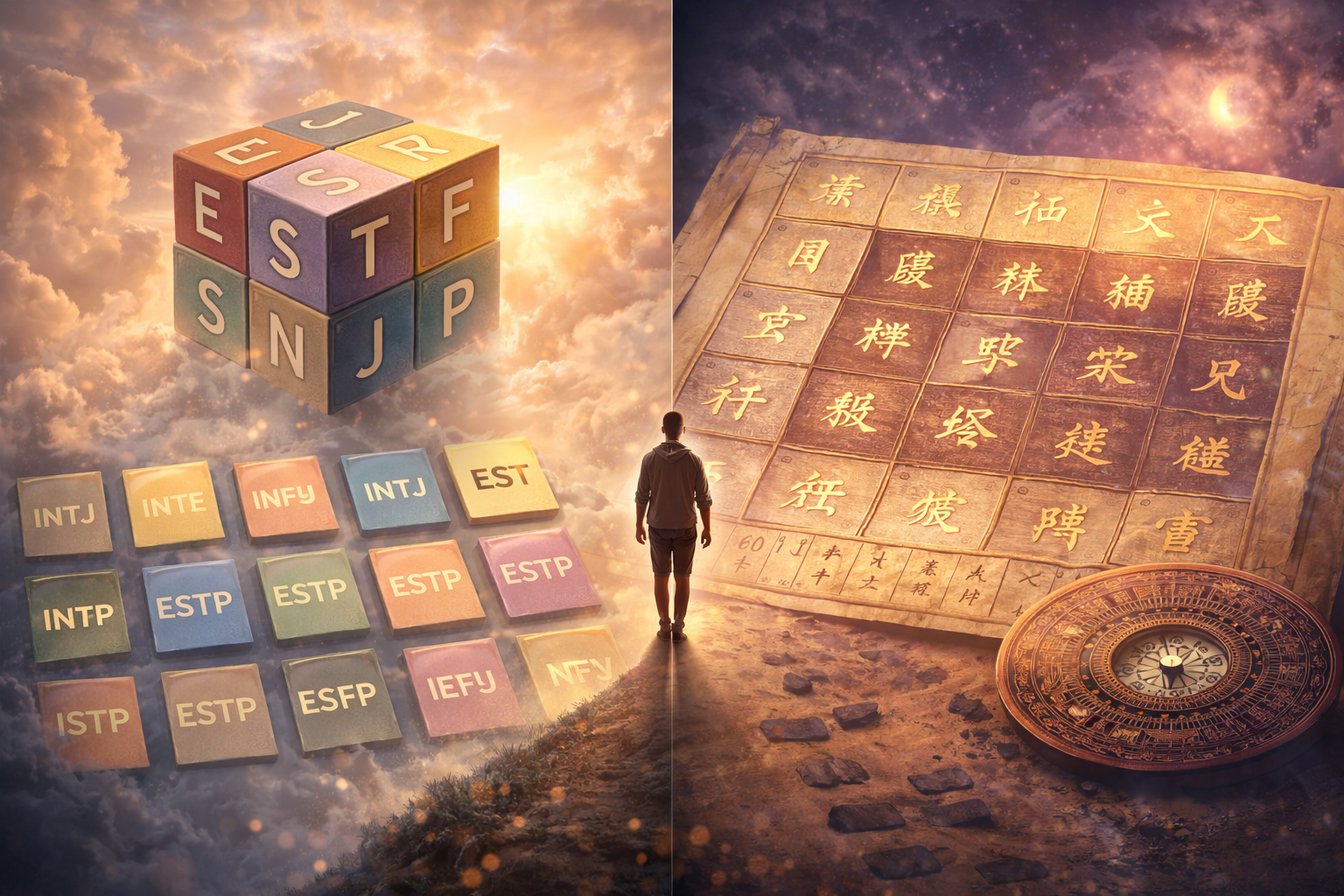
Why MBTI Changes but Your Zi Wei Chart Stays: 14 Main Stars vs 16 Personality Types
If you have taken MBTI multiple times, you have probably seen this: INFP one year, ENFP the next, INTJ under pressure, ESFJ in relationships. MBTI is useful, but it is still a snapshot of your present psyche.
Zi Wei Dou Shu (Eastern Imperial Astrology) works differently. It is not a flat label. It is a structural map showing where you naturally shine, where relationships repeatedly get stuck, and how your wealth model tends to operate over the long term.
Why MBTI Changes While Zi Wei Feels Stable
The core difference comes from three layers.
1. Flat Labels vs 3D Structure (Three-Way/Four-Direct)
MBTI gives four letters. Zi Wei reads a system.
- Life Palace: your core essence and baseline personality.
- Travel Palace (opposite palace): your external presentation and social mode.
- Trine palaces (Wealth + Career): your resources and execution style.
This is why one person can test as both "I" and "E" at different times: inner temperament may be reserved, while external behavior becomes highly assertive in high-stakes environments.
2. Relationship Destiny Structure (Star Placement Rules)
Zi Wei does not only define "you." It also maps how you repeatedly meet the world.
A Tianji-style person (The Advisor) often encounters strong authority dynamics in parent/boss structures. A Zi Wei-style person (Emperor archetype) often struggles with equal-peer cooperation and performs better when role boundaries are clearly defined.
MBTI tells you who you resemble. Zi Wei tells you which relationship scripts keep recurring.
3. Subconscious Drivers and Personality Contrast
Zi Wei is powerful at exposing the gap between your visible personality and hidden motivation.
You may look gentle, peaceful, and harmony-seeking, while internally carrying strong drives for achievement, resources, or emotional control. That tension is not hypocrisy. It is structural human complexity.
Signature Matchups: MBTI Archetypes vs Main Star Combos
These are not rigid one-to-one equations. They are high-frequency energy correspondences.
ENTJ Commander: Zi Wei + Qisha (The Pioneer)
- Zi Wei: leadership center, authority, dignity.
- Qisha: decisiveness, pioneering force, battlefield execution.
At high level: real leadership with accountability. At low level: control issues, pressure-heavy style, relational isolation.
INFP Mediator: Tiantong (The Harmonizer) + Tianxiang (The Minister)
- Tiantong: emotional sensitivity, comfort-seeking, idealism.
- Tianxiang: fairness, balance, social mediation.
Strength: empathy and relational repair. Blind spot: conflict avoidance, delay, emotional over-processing.
INTJ Architect: Tianji (The Advisor) + Jumen (The Advocate)
- Tianji: strategic thinking, iterative logic, opportunity sensing.
- Jumen: deep analysis, skepticism, argument precision.
Strength: elite strategic intelligence. Blind spot: over-analysis, delayed action, social friction.
ESTP Entrepreneur: Tanlang (The Wolf) + Pojun (The Rebel)
- Tanlang: desire, networking, resource mobilization.
- Pojun: break-and-rebuild, risk-taking, disruptive execution.
With discipline and resources, this can be explosive entrepreneurial energy. Without structure, volatility can become self-sabotage.
ISFJ Defender: Tianfu + Taiyin (The Moon)
- Tianfu: preservation, resource governance, stability.
- Taiyin: refinement, accumulation, security orientation.
This pairing is built for long-horizon wealth, not short-term adrenaline.
ENFJ Protagonist: Taiyang (The Sun) + Tianliang (The Sage)
- Taiyang: outward radiance, responsibility, public influence.
- Tianliang: principles, protection, moral framing.
Strength: social leadership and trust. Blind spot: burnout from over-giving.
How to Find Your Most Profitable Track by Main Star
MBTI suggests what role you may enjoy. Zi Wei goes further and indicates how your monetization mechanism works.
Action-Based Wealth: Wuqu (The General)
Wuqu wealth comes from execution, hard skills, and measurable output.
Good fields: finance execution, surgery, engineering, operations, disciplined sales.
Accumulation Track: Taiyin + Tianfu
- Taiyin: long-term planning, asset accumulation, real-estate logic.
- Tianfu: treasury mindset, stable investing, risk control.
Good fields: wealth management, CFO-style planning, supply chain, long-cycle business.
Voice-and-Analysis Track: Jumen
Jumen monetizes through insight, language, and argument.
Good fields: law, research, consulting, media commentary, education, content business.
High-Volatility Track: Tanlang + Pojun + Tianma
- Tanlang: traffic and social leverage.
- Pojun: opportunity in disruption.
- Tianma: movement-based wealth (the more dynamic, the better).
Good fields: cross-border growth, startups, BD, global commerce, rapidly changing sectors.
Four Transformations: Your Gas Pedal and Brake
Main stars are not enough. You also need the Four Transformations.
- Hualu: expansion and resource flow.
- Huaquan: concentration, control, execution pressure.
- Huake: visibility, reputation, social packaging.
- Huaji: blockage, obsession, forced restructuring.
The key is not "good vs bad." The key is timing: when to accelerate, when to stabilize, when to pivot.
Your Eastern Personality Code Is Structural, Not Random
MBTI tells you who you look like now. Zi Wei tells you why patterns repeat, where your friction points are, and how to reroute.
Beyond the 14 Main Stars, your chart is co-shaped by support stars such as Wenchang, Wenqu, Zuofu (The Active Supporter), Youbi (The Subtle Supporter), Tiankui (The Direct Patron), Tianyue (The Hidden Patron), Dikong (The Void), and Dijie (The Abyss).
You cannot redraw the terrain. But you can change route, speed, and strategy. That is the practical meaning of knowing fate and changing outcomes.
Want your own Main Star profile, relationship themes, money leverage points, and 10-year timing map?
Get your Zi Wei natal chart and unlock a full-depth report now.
If you want to bring these Zi Wei or annual-cycle patterns back to your real questions about work, relationships, or timing, try the Purplestarmapper free divination service and turn abstract metaphysics into a practical reading.
