Parallel Fates: Zhu Yuanzhang and the Beekeeper—Same Birth, Different Lives
In Chinese culture, we often hear sayings like “three cries at birth—your fate is set.” Many people revere their birth chart with near-deterministic awe, believing that the stars at the moment of birth have already written the ending.
But what if two people are born at the exact same minute and second? Would their destinies be identical?
A legend about the founding emperor of the Ming dynasty, Zhu Yuanzhang, offers a famous “human experiment” on this very question. Recorded in folk tales and unofficial histories, the story remains striking—and deeply philosophical.
The Emperor’s Anxiety: Who Else Could Take My Throne?
Zhu Yuanzhang (Emperor Hongwu) rose from poverty to the throne. From cowherd to novice monk to imperial ruler, his life reads like myth. Perhaps because his rise was hard-won, he took the idea of “Mandate of Heaven” more seriously than anyone.
After ascending the throne, a shadow lingered: if my imperial destiny comes from a rare birth chart, then anyone born on the same year, month, day, and hour might also carry the potential of the throne. If such people gathered and rebelled, the Ming dynasty would be in danger.
So he issued a secret order to find everyone who shared his exact birth time.
Thirteen Provinces vs Thirteen Beehives
Under the imperial investigation, a farmer from a remote village was brought to the palace.
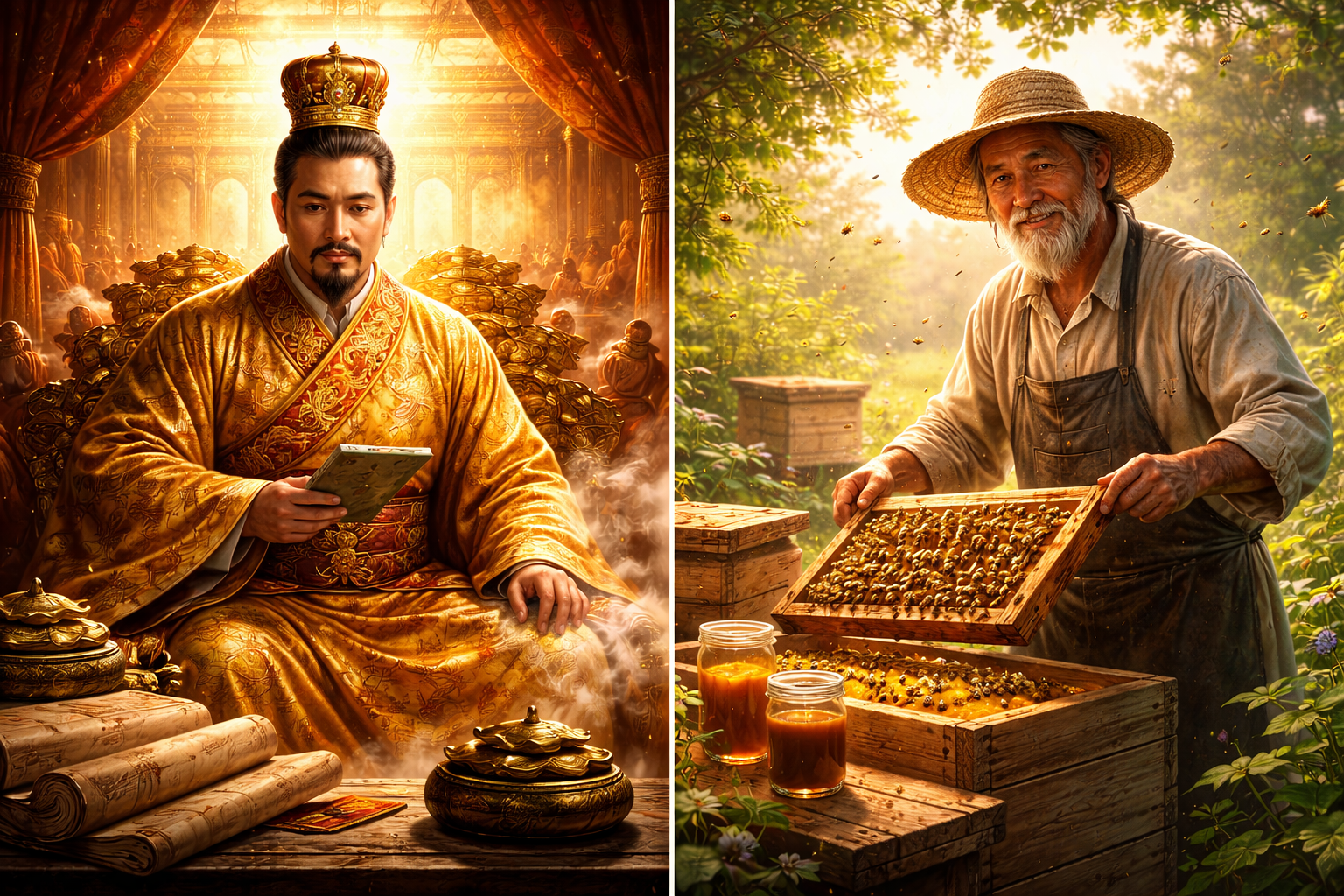
Zhu Yuanzhang sat high on the throne, eyes fixed on the trembling old man. One ruled the realm; the other tilled the soil. The emperor could not reconcile the gap: the same birth chart, yet such different lives.
He asked coldly, “What do you do in your daily life? How many people do you manage?”
The old man replied, “Your Majesty, I manage no people. I am a beekeeper. I’ve saved enough for thirteen beehives. I spend my days gathering flowers and tending the queen bee. That is my livelihood.”
Zhu Yuanzhang paused—then burst into laughter. His furrowed brow relaxed, and he rewarded the farmer.
The court was puzzled. The emperor explained, “I govern thirteen provincial administrations; he governs thirteen beehives. I rule millions of people; he rules thousands of bees. Our destinies are the same—only the field of play is different, and with it the scale.”
Why the Same Fate Leads to Different Outcomes
This tale shattered the idea of absolute determinism. It points to a core idea: seeds and soil.
1) Birth Chart as Seed, Environment as Soil
If a birth chart is a seed, both Zhu and the beekeeper held the seed of a giant tree.
Zhu’s seed fell into the fertile soil of war and upheaval—a storm of rebellion rich with opportunity. To survive, he had to root deeply and grow wildly, eventually becoming a towering tree.
The beekeeper’s seed fell into a quiet, resource-scarce village. Even with strong organizational talent, the maximum expression in that environment was managing bees with precision.
This teaches us: your starting traits define what you are, but your environment determines your scale.
2) The “Tailwind” of the Era and Personal Scale
In modern terms, we call it the “tailwind.” Zhu lived at the end of the Yuan dynasty—an era that forged heroes. Had he been born in peace, he might have become an excellent official—or a prosperous beekeeper.
The same birth chart in different eras produces different outcomes because the release of energy depends on the time’s current.
The “Pyramid Principle” of Fate
Ancient thinkers summarized fate in a famous line: “First destiny, second timing, third environment, fourth virtue, fifth learning.”
Many read this as a strict order, but it is really a combined force:
- Destiny (innate): temperament and talents. Both men had managerial ability.
- Timing (opportunity): Zhu met Guo Zixing; the beekeeper met bees.
- Environment: geopolitics, family background, social networks.
- Virtue: character, temperament, resilience.
- Learning: cognition and knowledge.
The farmer never sought imperial ambition, but owning thirteen hives in that era already made him a well-off local. Even in an ordinary role, he still expressed the “management talent” written into his chart.
Three Lessons for Modern Life
In today’s anxious world, we compare ourselves constantly. Why do classmates with similar grades end up with wildly different outcomes?
This story offers three practical lessons:
1) Admit Talent, Refuse to Stall
Same birth chart—one governs provinces, one governs bees. Everyone has a “baseline platform.” If you have leadership, you can shine as a Fortune 500 CEO or a community organizer. The question is: have you found your thirteen “beehives”?
2) Choose Your Soil
If your talent feels trapped, the soil may be wrong. The beekeeper could only keep bees in a mountain village; Zhu built an empire in a military camp. Modern people have more mobility—sometimes changing circles or cities changes the scale of life.
3) Your Scale Sets Your Ceiling
Zhu’s laughter came from insight: the size of your heart sets the size of your stage. The beekeeper was content with honey; Zhu aimed for the realm. You do not need to be an emperor—but you should know whether your current pursuit matches your gifts.
Conclusion
Fate is not a fixed line but a function with variables.
The story of Zhu Yuanzhang and the beekeeper does not preach fatalism. It reminds us that the same energy can become a blazing star or a warm candle. Instead of asking whether your fate is “good,” ask: where are your thirteen beehives? Have you pushed your gifts to their true limit within your current conditions?
The next time you feel overlooked, remember the old beekeeper. Perhaps you carry an emperor’s seed—quietly tending a forest of bees while waiting for your own season to arrive.
